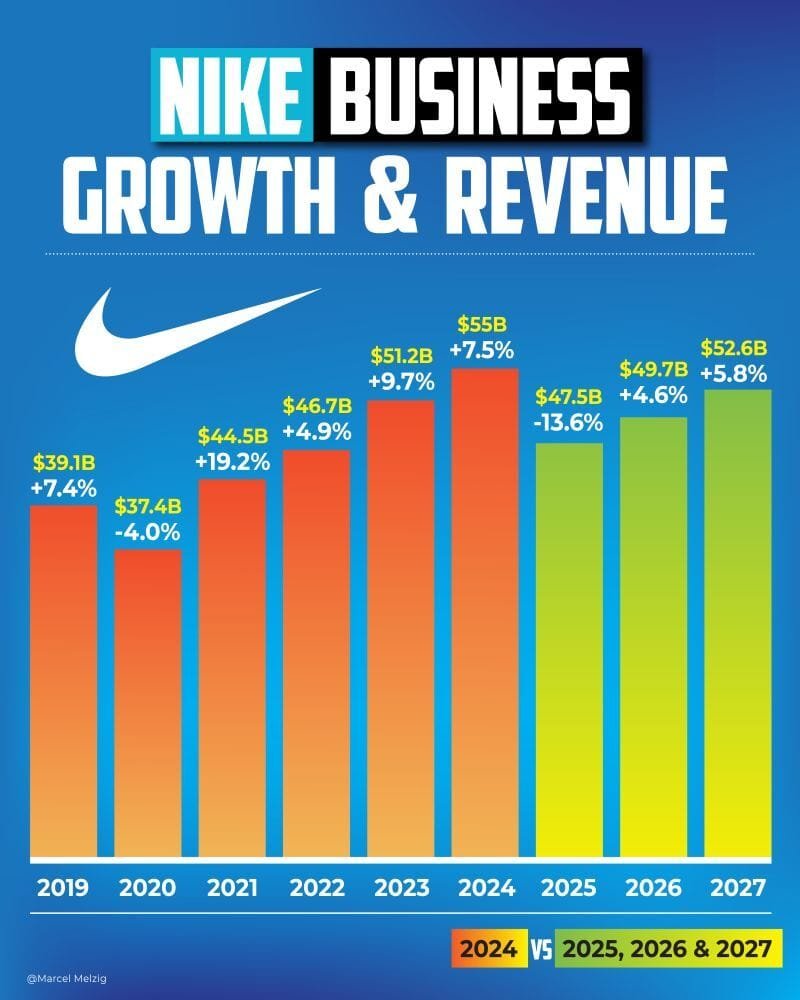
Nike's turnaround: revenue, channels and what comes next
Nike's revenue fell 10% to $46.3 billion in fiscal 2025 and stayed flat at $46.4 billion in fiscal 2026. For fiscal 2027 Nike expects another decline. Here are the reported numbers, and what they mean for brands and retailers in Europe.
By Marcel Melzig · First published 27 February 2025 · Updated 8 November 2026
Short answer: Nike reported revenue of $46.3 billion for fiscal 2025 (June 2024 to May 2025), down 10% from $51.4 billion. In fiscal 2026 revenue was $46.4 billion, flat on a reported basis and down 2% currency-neutral. In the first quarter of fiscal 2027 (June to August 2026) revenue fell 4% to $11.2 billion.
$46.4bnRevenue, fiscal 2026
−10%Fiscal 2025 vs. 2024
+6%Wholesale, fiscal 2026
−6%Nike Direct, fiscal 2026
Nike revenue by fiscal year
Period
Revenue
Change, reported
Currency-neutral
Fiscal 2024 (to 31 May 2024)
$51.4bn
–
–
Fiscal 2025
$46.3bn
−10%
−9%
Fiscal 2026
$46.4bn
flat
−2%
Q1 fiscal 2027 (Jun–Aug 2026)
$11.2bn
−4%
−5%
Fiscal 2027 outlook
–
high single-digit decline
–
Nike's fiscal year ends on 31 May. All figures from Nike's reported results, see sources below.
The channel shift: wholesale is back
Channel
Fiscal 2025
Fiscal 2026
Q1 fiscal 2027
Nike Direct
$18.8bn (−13%)
$17.7bn (−6%)
$4.1bn (−8%)
Wholesale
$25.9bn (−7%)
$27.5bn (+6%)
$6.8bn (−1%)*
* Nike Brand wholesale. Changes on a reported basis.
For years Nike pulled volume out of wholesale and into its own stores and app. The numbers now show the reversal: in fiscal 2026 wholesale grew 6% while Nike Direct fell 6%. Digital is the weakest part. Nike Brand Digital was down 13% in the first quarter of fiscal 2027.
For retailers that means better access to product again. It does not mean easy sell-through. CFO Matthew Friend said in June 2026 that sell-through "remains challenged".
Where it hurts: China and EMEA
In the first quarter of fiscal 2027 the decline came mainly from Greater China and EMEA, while North America grew. Footwear was the weak spot at $7.0 billion (−6%); apparel grew 2% to $3.4 billion. Nike's press release does not give an exact EMEA figure for the quarter, so I don't put a number on Europe here.
What is working: running
CEO Elliott Hill said on the June 2026 earnings call that Nike Running had grown double digits for five consecutive quarters, adding about $1 billion, and that Nike had gained five points of running share in Western Europe and North America. These are company statements, not audited market data. They fit the wider market, though: running is the strongest footwear category in Europe right now (see who is gaining share in Europe).
Margin and cost: the Pace programme
Gross margin moved from 42.7% in fiscal 2025 to 42.9% in fiscal 2026 and 42.8% in the first quarter of fiscal 2027. In October 2026 Nike announced Pace, an operating-model overhaul targeting about $2.5 billion in cumulative savings through fiscal 2031, with around $1 billion in charges, mostly employee-related.
What it means for brands and retailers
Plan Nike as a recovering partner, not a growth engine. Nike itself guides to another decline in fiscal 2027.
Expect better allocation, not automatic sell-through. Wholesale access improves; full-price sell-through doesn't follow by itself.
Back running. It is the category where Nike reports growth. The pressure sits in lifestyle footwear.
Watch the white space. Where Nike pulls back, On, ASICS, New Balance and HOKA are growing 15 to 30% a year worldwide (see who is gaining share).
What I'm watching next
Second-quarter results, expected in December 2026: does wholesale stabilise?
EMEA: does the decline narrow over the next two quarters?
Nike Direct: when does digital stop shrinking?
Correction: The February 2025 version of this article relied on a forecast and stated that Nike's revenue peaked at $55 billion in 2024. That was wrong: reported revenue for fiscal 2024 was $51.4 billion. All figures now come from Nike's reported results.